Well water softeners and filters: iron, sulfur smell and sediment
A private well brings its own mix: hardness, often higher than the city's, plus iron that stains, a rotten-egg smell from hydrogen sulfide, and sand. A softener handles hardness and a little dissolved iron. Everything else needs its own stage in front of it, and the water test decides which stages.
What the problem looks like
Each symptom points to a different kind of treatment. Test before buying: the Florida Department of Health recommends testing a private well for bacteria and nitrate at least once a year through a state-certified lab, and the same lab can run iron, manganese, hardness and pH.
Clear from the tap, stains later
Clear-water iron
Dissolved (ferrous) iron. Water runs clear and turns orange in the toilet bowl or on the fixtures as it meets air. A softener with fine mesh resin removes a few ppm of it along with hardness.
Orange from the tap
Red-water iron
Iron that has already oxidized. It clogs softener resin, so it needs an oxidizing filter or sediment stage ahead of the softener. Penn State Extension notes that oxidized iron clogs resin.
Rotten eggs
Hydrogen sulfide
A sulfur smell from cold and hot taps points to the well. Air-injection filters oxidize it along with iron. A smell only from hot water usually comes from the water heater's anode rod reacting with the water.
Grit in the aerators
Sand and sediment
A spin-down or cartridge sediment filter right after the pressure tank protects every stage after it, and the valve seals in particular.
Quick picks
The short answer for common situations. Each links to the full card below.
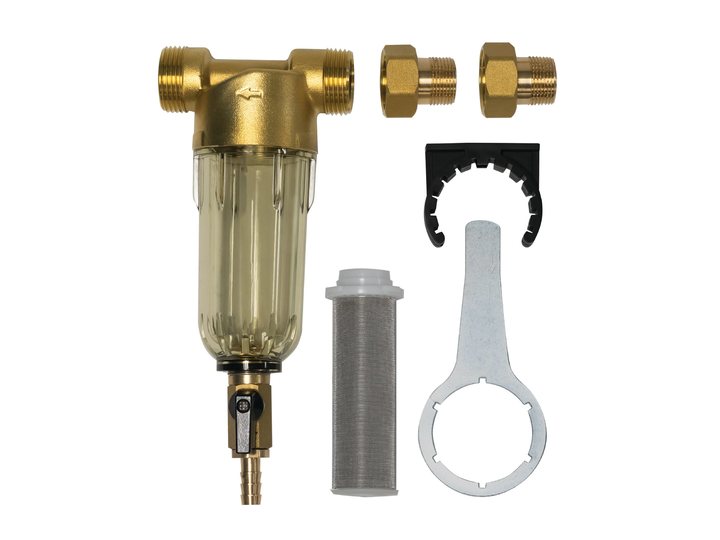
A flushable stainless screen after the pressure tank protects everything downstream.
Compare well-water systems
Iron, manganese and sulfur limits are the sellers' claims and are labeled as such. A softener's iron limit applies to clear-water (dissolved) iron only.
Product links on this page go to Amazon. If you buy through them, Which Water Softener earns a commission. How we pick and earn
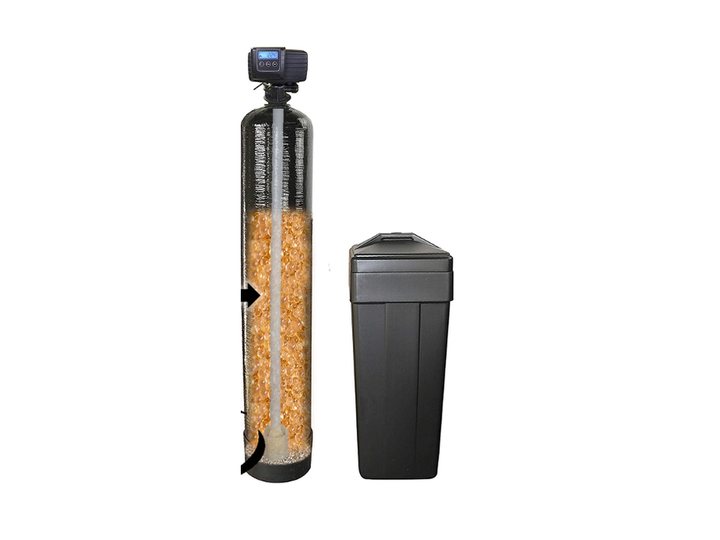
The same 5600SXT valve and 10 x 54 in tank as the city-water build, filled with fine mesh resin, which exchanges dissolved iron along with hardness. AFW pitches it for well water carrying both.
Valve
Fleck 5600SXT, digital metered
Resin
1.5 cu ft fine mesh
Tank
10 × 54 in; brine tank 14 × 14 × 36 in
Flow
6.5 gpm service, 9.8 gpm peak (AFW)
Seller claims
Hardness up to 70 gpg, iron up to 4–7 ppm, manganese up to 6 ppm (listing)
Suits: A well with hardness and a few ppm of clear-water iron, where one tank has to handle both.
Weigh: The iron and manganese figures are AFW's claims. Red water, bacterial iron or a rotten-egg smell need an oxidizing filter ahead of any softener, and every ppm of iron uses up softening capacity.
DuraWater Air Injection Iron Eater 1.0, Fleck 5600SXT
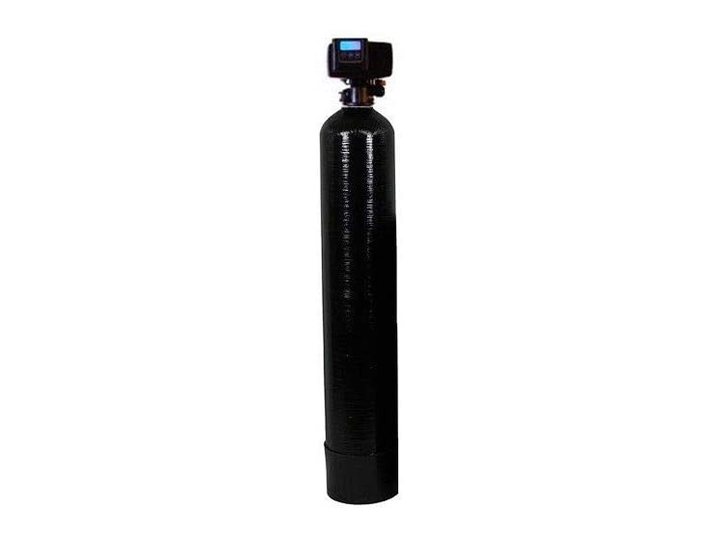
A Fleck 5600SXT valve that draws a pocket of air into the top of the tank each regeneration. Iron and hydrogen sulfide oxidize as the water passes through the air, the media bed traps the particles, and the valve backwashes them to drain. No salt or chemicals.
Valve
Fleck 5600SXT air injection (DuraWater)
Media
1.0 cu ft in a 10 × 54 in tank, 1 in bypass
Rated for
Iron up to 8 ppm, H2S up to 4 ppm, manganese up to 2 ppm (AFWFilters)
Flow
Not published
Suits: A well with moderate iron and a sulfur smell, ahead of a softener.
Weigh: The two sellers of this listing disagree: DuraWater claims 17 ppm iron and 8 ppm H2S, while AFWFilters sells the same item rated for 8 ppm iron, 4 ppm H2S and 2 ppm manganese. The lower figures are quoted here. AFW says air injection needs a pH above 6.8 to work efficiently, and the backwash needs a drain and enough pump flow.
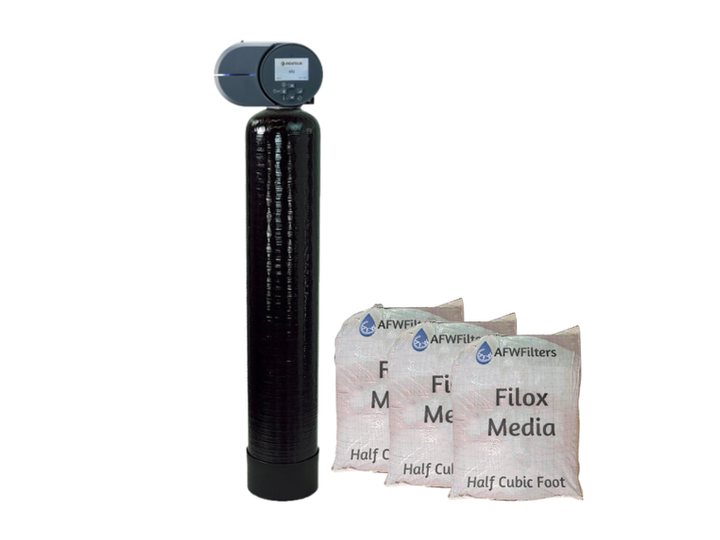
AFW's top air-injection tier: 1.5 cu ft of Filox media in a 12 x 52 in tank on the larger Fleck 2510 valve. AFW rates it for iron up to 20 ppm, hydrogen sulfide up to 15 ppm and manganese up to 6 ppm, and puts it first in line ahead of the softener.
Suits: Strong sulfur smell or heavy iron, on a well pump that can deliver the backwash flow.
Weigh: It needs 9.4 gpm for backwash, which a weak well pump cannot supply; test the pump first. AFW warrants the control head for 1 year. The Amazon listing claims 27 ppm iron; AFW's own store says 20.
Cartridge filter: sediment, carbon, iron and manganese
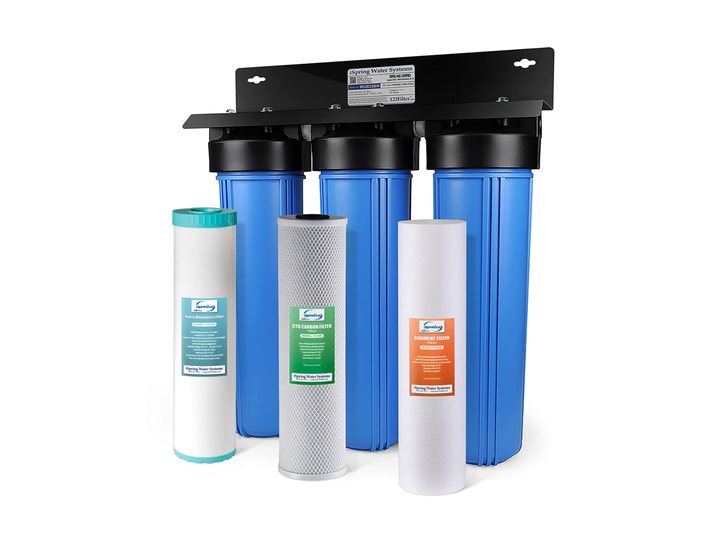
iSpring WGB32BM 3-stage with iron cartridge
iSpring WGB32BM
Three 4.5 x 20 in housings: a 5-micron sediment cartridge, a carbon block, and a catalytic cartridge that iSpring rates to take iron from 3.0 ppm and manganese from 1.0 ppm down to 0.01. No drain, power or backwash.
Stages
5-micron sediment, carbon block, catalytic iron and manganese
Rated for
Iron up to 3.0 ppm, manganese up to 1.0 ppm
Cartridge life
Iron 50,000 gal at 3.0 ppm; others 100,000 gal or 12 months
Flow
15 gpm peak; 25–80 psi; pH 6–11
Ports
1 in NPT
Suits: Low iron on a well with no drain near the equipment, or a small house where a tank filter is more than the job needs.
Weigh: Iron tops out at 3 ppm, and the iron cartridge is rated for 50,000 gallons at that level, so cartridges are a running cost. iSpring says to put a spin-down ahead of it on sandy water.
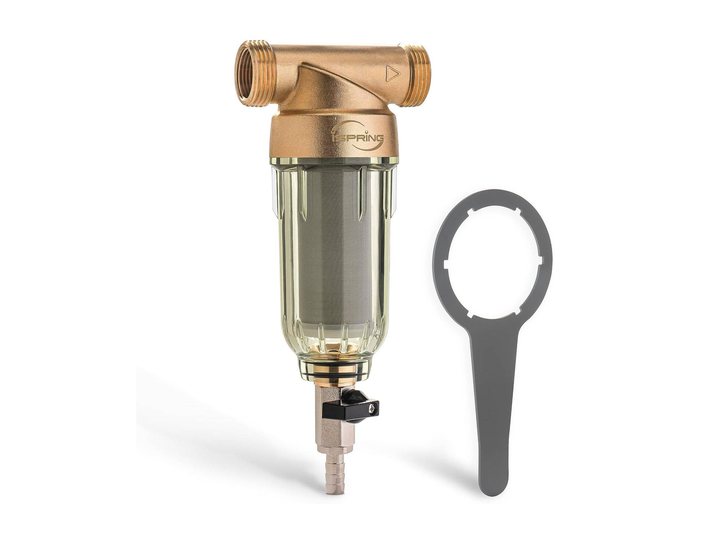
A stainless mesh screen in a clear housing on a brass head, with a flush valve at the bottom. Sand and grit spin down and are flushed out by opening the valve. It does nothing for dissolved iron or smell.
Screen
Stainless, 50 micron; 100 to 1,000 micron screens sold separately
Ports
1 in MNPT and 3/4 in FNPT, brass head
Water
15–115 psi, 40–100 °F
Screen life
"Usually lasts 1–2 years" (iSpring)
Suits: Sandy well water, right after the pressure tank and ahead of every other stage.
Weigh: iSpring warns that 50 and 100 micron screens can clog quickly on water with a lot of sediment; coarser screens are sold for that. Indoor only.
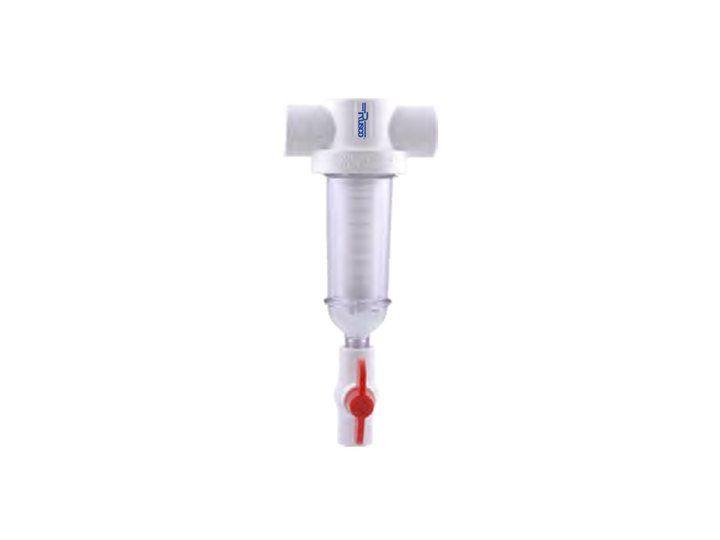
The long-running American spin-down: a clear housing with a replaceable screen and a flush valve, in PVC. Rusco sells screens from 24 mesh (700 micron) to 1,000 mesh (15 micron); 60 mesh is 250 micron, a coarse first stage for sandy wells.
Screen
60 mesh (250 micron), polyester
Flow
1–25 gpm
Pressure
150 psi maximum
Ports
1 in slip (Rusco)
Warranty
12 months
Suits: Heavy sand, where a fine screen would clog in days. Often paired with a finer screen or cartridge after it.
Weigh: Rusco's page lists 1 in slip ports, while the listing title says threaded; check before ordering fittings. Hand tighten only: Rusco says tools void the warranty.
A reusable sediment screen in a clear housing on a stainless mount, with a pressure gauge and a pressure-release button for changing the screen. Express Water rates it at a quarter gallon per second, 15 gpm.
Screen
50 micron (listing), reusable
Flow
15 gpm (0.25 gal per second, Express Water)
Water
15–115 psi, 40–113 °F
Ports
1 in, with 3/4 in adapters (listing)
Suits: A sediment first stage where a gauge on the housing is useful for seeing when the screen is loading up.
Weigh: The 50 micron rating and the 3/4 in adapters come from the listing; Express Water's own page gives no micron figure. 1-year warranty.
Pressure tank, then sediment, then iron and sulfur, then the softener, then any carbon or UV. Each stage protects the next: sand scores valve seals, oxidized iron fouls resin, and a softener only handles the iron that is still dissolved when it gets there.
Iron uses up softening capacity
Softener sizing counts each ppm of iron as several grains of hardness; the sizing calculator uses 4. A well at 15 gpg with 2 ppm of iron sizes like 23 gpg water. Above a few ppm, or with any red water, a separate iron filter is cheaper to run than a softener regenerating every few days.