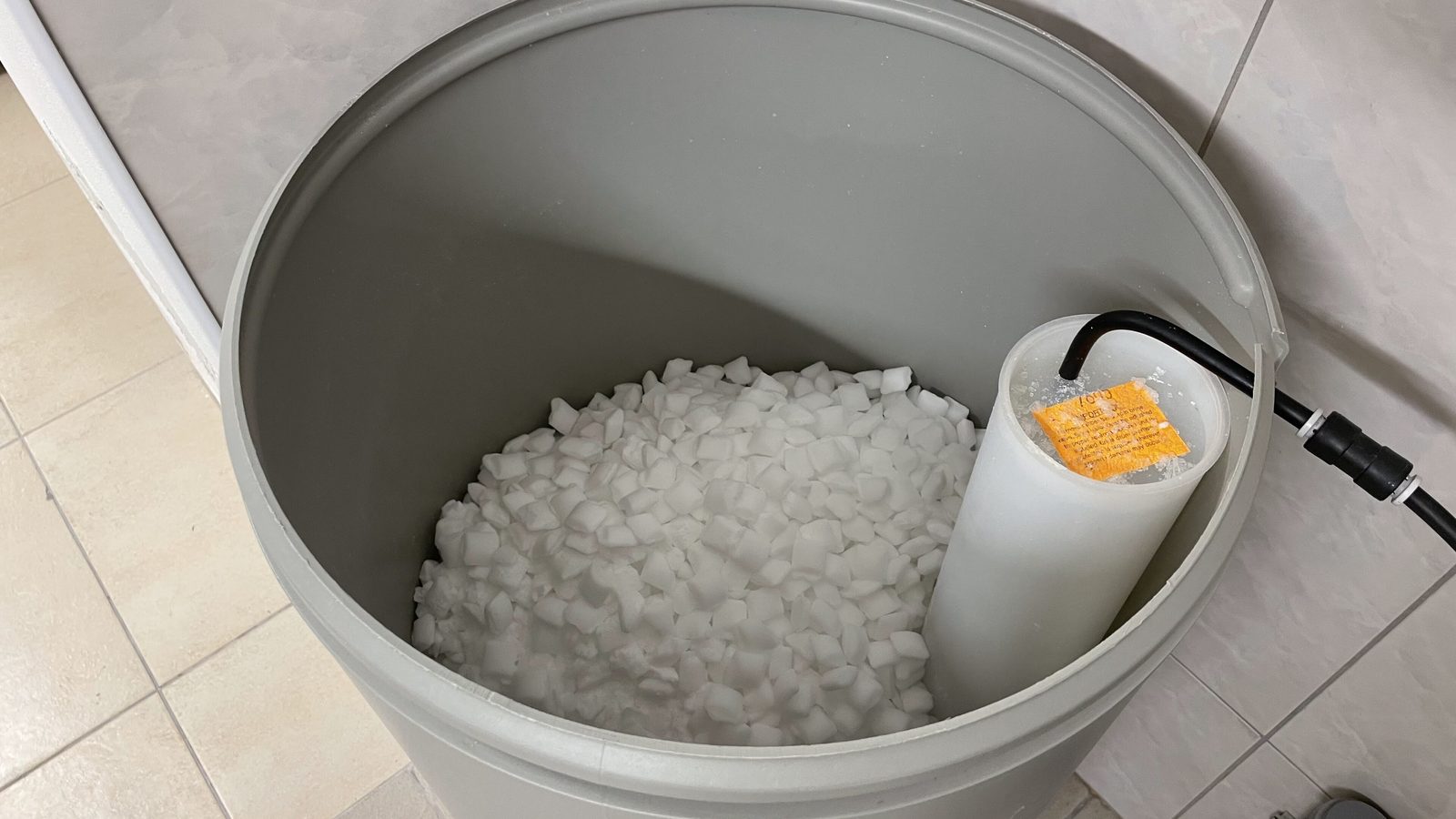
The salt never reaches your taps. It dissolves in the brine tank to make the brine that cleans the resin, so what matters is how cleanly it dissolves and what it leaves behind.
The kinds on the shelf
- Evaporated salt pellets. Made by evaporating brine and pressing the crystals into pellets. The purest of the common types, with the least insoluble residue. Usually the higher price per bag.
- Solar salt crystals. Made by evaporating seawater or brine in ponds. Slightly less pure than evaporated salt, and some brands leave more insoluble matter in the tank. Aquasure’s manual recommends “extra coarse grade or crystal” salt.
- Rock salt. Mined and crushed. The cheapest, and it carries the most insoluble material, which settles as sludge in the brine tank. Aquasure’s manual says not to use it.
- Potassium chloride. A sodium-free alternative sold in the same aisle. It works in the same softeners and costs several times as much per bag.
Avoid table salt, block salt and ice-cream salt in a brine tank. Aquasure lists block, granulated and ice-cream salt with rock salt as salts not to use, and wants at least 99.5 percent purity.
Bridging and mushing
A salt bridge is a hard crust that forms above the water line, so the refill water no longer reaches the salt. Mushing is a sludge of recrystallized salt at the bottom of the tank. Humidity and fine or dusty salt make both more likely, and both stop brine from forming. Pellets and coarse crystals leave more space between pieces. Fill the tank only partway in a humid space, and check it with a broom handle each month. The troubleshooting guide covers breaking up a bridge.
Potassium chloride
Potassium chloride regenerates resin less efficiently than sodium chloride. GE’s support guidance is to set the hardness 20 percent higher when using it, so the valve regenerates sooner and uses more of the more expensive salt. It suits a household that wants to avoid the added sodium: Penn State Extension puts sodium from a softener at 7.5 mg per quart for each grain per gallon removed, which is about 90 mg per quart at 12 gpg.
How much salt a year
That depends on hardness, water use and the salt setting more than on the softener. A family of four at 12 gpg on a 48,000-grain softener set to 8 lb per cubic foot regenerates about every nine days and uses roughly 500 lb a year, about a dozen 40 lb bags. The sizing calculator works it out for your numbers, in pounds and 40 lb bags.
Switching kinds
Use up what is in the tank, or clean it out, before changing to a different salt. When switching to potassium chloride, raise the hardness setting first. Mixing kinds is harmless; residue from rock salt stays until the tank is cleaned.